
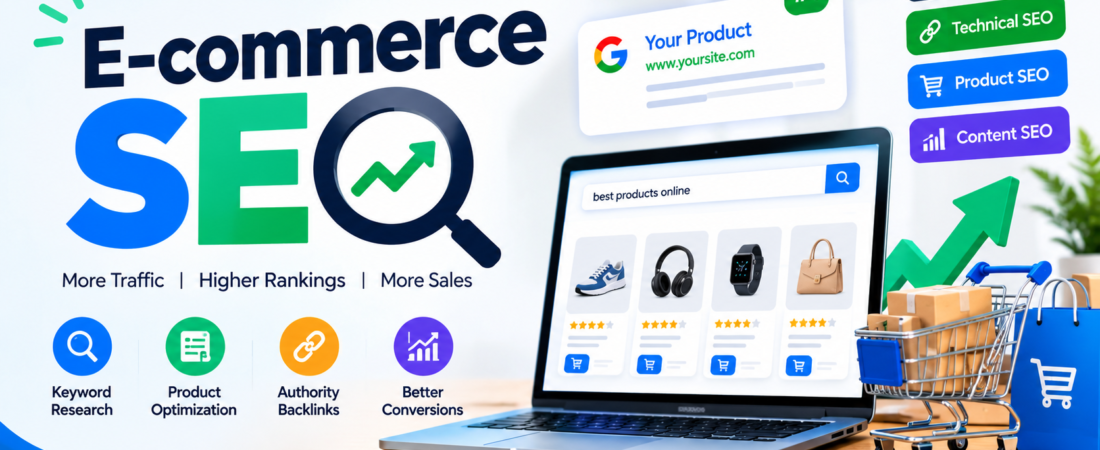
E-commerce SEO is one of the most effective ways to attract potential customers to an online store by search results. Whether you sell clothes, electronics, cosmetics, home appliances or digital products, a well-developed strategy will help your website appear in the search results for the right keywords and increase sales.
It is no longer enough to simply create a store and wait for customers to find you on their own. Companies must invest money, effort and time to optimize existing products and create new ones. This guide covers everything you need to know about e-commerce SEO, including why it is worth focusing on and what specific optimization strategies are used.
What Is E-Commerce SEO?
E-commerce SEO refers to optimizing an online store’s page so that it appears in search results for relevant queries. This process includes keyword research, on-page optimization, technical SEO, content creation, internal linking, and building quality backlinks.
For example, a person searching for “wireless headphones for everyday use” is likely to see a properly optimized product or category page in the search results. Unlike paid promotions, SEO does not require a company to spend money on each click. However, it does take time and effort to achieve stable results.
Why Is E-Commerce SEO Important?
E-commerce SEO allows companies to find the right customers, increase website traffic, and promote products. Below are some of the most important benefits that an online store can get from optimizing its search capability.
Attract More Organic Traffic
Search engines can be a great source of traffic for any online store. A company can appear in search results for relevant queries so that potential customers can find you. Moreover, SEO helps attract users who are already looking for a product similar to what the company is selling.
Promote Your Products
Properly optimized product and category pages help increase a page’s visibility in search results for relevant queries. This, in turn, increases the number of visitors to the website. It is important to optimize information so that search engines can easily read and understand it.
Build Trust with Customers
Many customers research products online before buying. The presence of relevant, high-quality information helps to increase the company’s credibility and provide a good user experience. This also has a positive effect on conversion rates and sales.
Get Long-Term Results
Unlike paid promotions, SEO has a long-term effect. Even after the end of paid campaigns, an online store continues to receive traffic from search engines. However, the number of visitors may vary depending on the competition and optimization level of each page.
Essential E-Commerce SEO Strategies
E-commerce SEO is a complex process that includes many optimization techniques. A large online store may use dozens of different strategies at once. Below are ten proven ways to optimize an e-commerce website.
Conduct E-Commerce Keyword Research
Keyword research is the basis of any SEO campaign. The results of this study will help you understand which terms your potential customers are looking for and what queries they are using. First of all, you need to analyze the goods that the company is selling and group them into categories. Next, you need to conduct keyword research to find the most relevant and popular terms for each category.
There are several types of keywords:
Informational keywords: how to choose a laptop for work
Commercial keywords: best wireless headphones for students
Transactional keywords: buy wireless headphones
Long-tail keywords: lightweight wireless headphones with long battery life
The use of long tail keywords in the URLs of an online store may be especially relevant for small businesses. In addition, it is important to consider the search intent behind the search. The product page should respond to the request using a specific product, while a blog article, for example, should answer a more general question.
Optimize Product Page
A product page is a document that provides information about a particular product. This type of page is one of the most important on an e-commerce website as it is where a customer decides whether to make a purchase. Each product page should have a unique page title, product description, photos, price indication, and product characteristics.
To optimize the page, use the following tips:
1. Use the main keyword in the product name.
2. Do not copy the description from suppliers. Instead, write unique texts describing the features and advantages of the product.
3. Always indicate the characteristics and specifications of the product.
4. Do not stuff keywords; use them naturally in the product description.
5. Show the current availability of the product and its cost.
6. Publish customer reviews on product pages.
7. Add buttons such as “Add to cart.”
Optimize Category Page
The category page groups similar products together. For example, the category page of an electronics store may include laptops, headphones, computer mice, and accessories. Using the tips listed below, you can optimize category pages and improve their visibility in search results.
Make sure the heading of the page clearly indicates which products are in it. Add unique descriptions and use special filters so that customers can find what they are looking for quickly. Besides, internal optimization techniques such as anchor text and internal links should also be used on category pages. Do not forget about the importance of convenient navigation and avoiding the creation of similar category pages with the same content.
Optimize Technical SEO
Technical SEO refers to optimizing a website’s technical characteristics to improve its visibility in search results. First of all, this includes optimization of website performance, which directly affects the page experience. To increase the speed of a website, it is necessary to reduce the file size of photos, delete unnecessary scripts, and optimize the server settings. You can track changes in performance indicators using the Core Web Vitals tool.
In addition, technical SEO includes optimizing an online store for mobile devices. Make sure the website displays properly on smartphones and tablets so that customers do not have any difficulties when browsing pages. Other optimization techniques include creating an XML sitemap, fixing broken links, and eliminating URL duplicates. Using proper canonical tags, you can inform search engines which page should be ranked higher if similar content appears on different pages.
A secure connection (HTTPS) increases the security of data transmission on a website and builds customer trust. Regular technical audits allow you to identify and fix problems before they affect the entire site.
Create Useful Content
An e-commerce website should not only have product descriptions but also informational content about the goods. Articles help answer customer questions, collect useful statistics, and attract more traffic. Moreover, content marketing helps attract the attention of potential customers and build an emotional connection with the brand.
For example, you can create articles comparing the characteristics of different products or write a review about a certain company’s product. A home accessories store can publish an article titled “how to choose storage space in a small apartment.” Such content may also include internal links leading to relevant product categories so that customers can quickly find the desired product.
It is important to create high-quality, informative content that demonstrates a good understanding of the topic. Avoid low-quality articles that only contain keywords.
Build Quality Backlinks
Backlinks are links from other websites that point to your website. This type of SEO is important because it helps search engines find relevant pages and rank them higher in search results. When choosing which websites to acquire backlinks from, it is important to focus on quality over quantity. A small number of high-quality backlinks will bring more value than thousands of irrelevant links.
There are several proven techniques for building quality backlinks for e-commerce stores.
Guest blogging allows you to reach a larger audience by publishing articles on third-party websites. The link in the author bio will drive traffic to your website. Digital PR refers to publishing special research or articles on third-party websites that provide useful information to customers. In addition, you can build relationships with webmasters so that they can recommend your store and write articles about your company. Another method is to collect useful information about products and publish them on third-party resources so that they can recommend your website to their customers.
An e-commerce store should avoid buying backlinks and participating in link schemes. Google has strict spam policies and can penalize websites with suspicious incoming links.
Use Internal Linking
Internal links are used to connect web pages within one site. They help customers find related pages faster and increase the overall relevance of a website. When optimizing internal linking, it is important to follow a few simple rules:
1. Link relevant blog posts to appropriate product and category pages.
2. Connect related categories and subcategories so that it is easier for customers to find the desired information.
3. Give priority to important product categories and pages.
4. Use relevant anchor text when linking.
5. Avoid linking if the topic of the two pages is completely different.
A properly built system of internal links helps increase the relevance of web pages and provide customers with a better experience.
8. Optimize Product Images
Product images play a big role in online shopping. Choosing the right size and format helps increase the speed of a website without sacrificing visual appeal. It is important to optimize the file size of images so that they can be downloaded without problems on any device. In addition, it is important to hide images behind text so that search engines can read and understand the content of the page.
You should also optimize the filename and alt text for images so that they reflect the content of the page. For decorative images, the alt tag can be left blank. Make sure that search engines can see all the important images on your website.
Add Product Structured Data
Many search engines use special structured data to help organize information. Wherever possible, use Product structured data to help search engines understand what products are on your website. This data type allows you to show rich snippets in search results by providing information about the name, image, price, currency, and availability of goods.
Make sure that the structured data corresponds to the actual content on the page. In addition, you need to consider the requirements and recommendations of search engines for displaying product data. Using this type of optimization does not guarantee that your products will appear in the rich snippets, but it will help increase the visibility of your website in the search results.
Analyze and Track SEO Performance
SEO performance should be analyzed and measured on a regular basis to identify the most effective optimization tactics. To do this, you need to study the data provided by Google Search Console and Google Analytics.
The most useful metrics for e-commerce SEO include organic traffic, search queries, page impressions, and landing page visits. In addition, it is important to track the performance of individual product and category pages, as well as overall conversion rates, sales, and revenue. Finally, you need to look at technical SEO metrics such as indexing problems.
Keep in mind that the number of backlinks and the position of a page in search results are not the only indicators of SEO success. A landing page that is not performing well may be drawing in the wrong audience. By analyzing the available data, a company can identify the strengths and weaknesses of its SEO performance and optimize the most problematic areas.
Common E-Commerce SEO Mistakes to Avoid
There are several common mistakes that online stores make when optimizing their SEO. First of all, you should not copy the descriptions of manufacturers’ goods. In addition, you should not neglect the technical characteristics of a website such as speed or mobile-friendliness. A company should also avoid having products that are difficult to find on a website.
Other mistakes include keyword stuffing, creating many similar pages with the same content, ignoring the importance of internal linking, and acquiring low-quality backlinks. Finally, it is important to remember that SEO is a long-term process, so it does not make sense to constantly change optimization tactics in an attempt to get results quickly.
Conclusion
E-commerce SEO is a time-consuming but worthwhile process that increases an online store’s visibility in search results. By optimizing keywords, product and category pages, technical characteristics, and promoting useful content, companies can achieve stable increases in organic traffic. A well-developed SEO strategy will allow you to find the right customers and increase sales.
The most effective way to optimize an e-commerce store is to combine search engine optimization with a high level of user experience. Maintaining high quality of information, convenient navigation, and ongoing technical improvements will help your website move up in search results.